

CCM & RPM Consulting for Compliant, Scalable Care Programs
Design, launch, and optimize Chronic Care Management and Remote Patient Monitoring—without compliance guesswork.
Citrus Healthcare Consultants helps healthcare organizations plan, implement, and sustain compliant Chronic Care Management (CCM) and Remote Patient Monitoring (RPM) programs that actually work in real‑world clinical environments. We focus on workflow clarity, documentation integrity, operational readiness, and audit resilience—not hype or shortcuts.
Important Notice: This page is for educational purposes only and is not legal or reimbursement advice. Coverage and payment rules vary by payer and change frequently. Always verify requirements with CMS, commercial payers, and/or qualified counsel.

Why CCM and RPM Matter
Chronic disease management increasingly happens between office visits. CCM and RPM are care delivery models designed to support patients outside the clinic—when medication issues arise, symptoms fluctuate, or vital signs trend in the wrong direction.
When implemented correctly, these programs can:
Improve care coordination across clinical and non‑visit time
Support proactive interventions
Strengthen documentation and continuity of care
Align care delivery with value‑based principles
When implemented poorly, they can:
Create documentation gaps
Increase audit exposure
Overburden staff
Lead to denials or recoupments
Our role is to help organizations get it right—by design.

CCM and RPM Together:
Complementary, Not Duplicative
CCM and RPM can be used together, but they are distinct services with separate documentation expectations.
Key principles:
Care activities must be clearly attributable to the correct service
Time cannot be counted twice
Workflows must distinguish care coordination vs. data‑driven intervention
Documentation must show medical necessity for each service
Common Pitfall:
Running CCM and RPM in parallel without clear role definitions or time attribution—creating compliance risk even when excellent care is being delivered.
We help organizations design integrated workflows that respect these boundaries.

Compliance & Audit Readiness:
What Programs Must Get Right
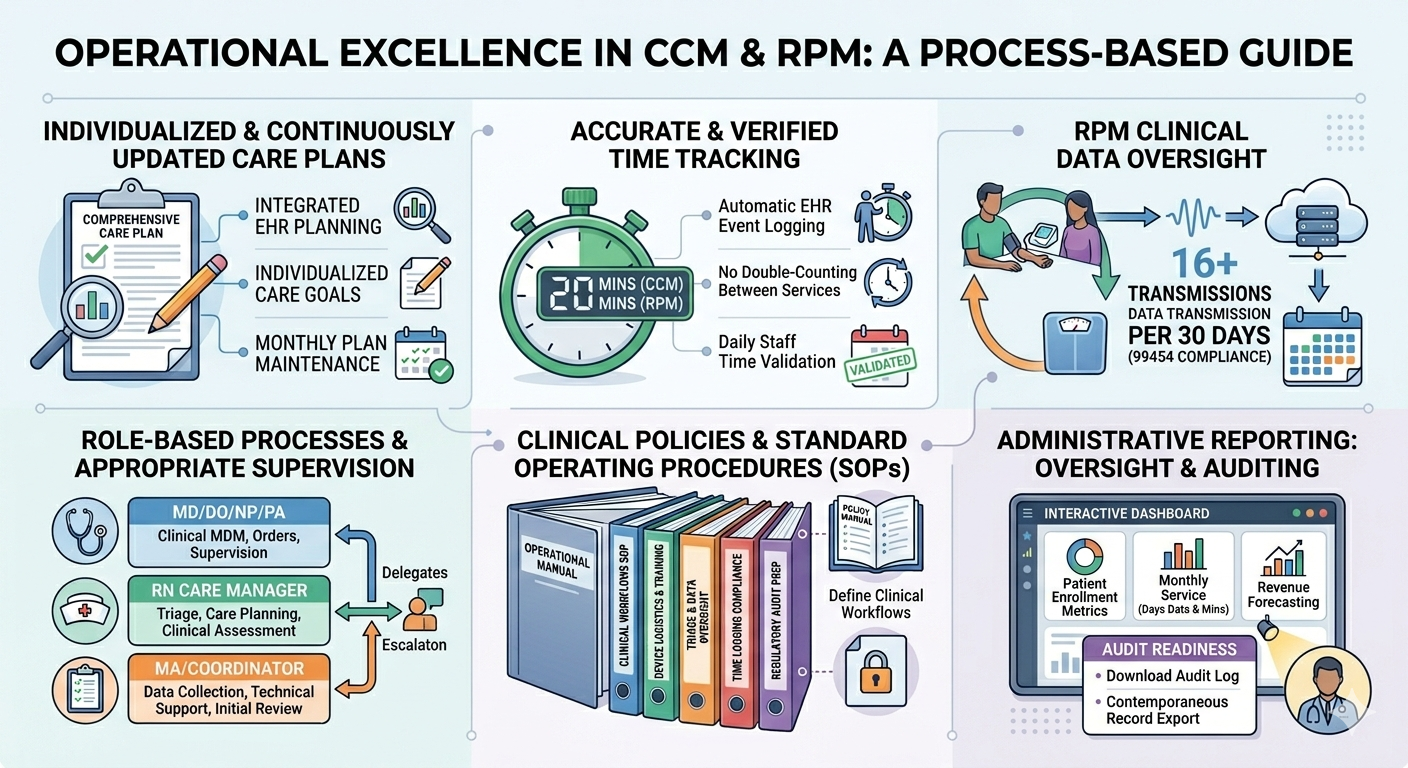
While requirements vary by payer, compliant programs typically address:
Patient consent (documented and retained)
Care plans that are individualized and maintained
Time tracking that is accurate and contemporaneous
Device and data requirements for RPM
Role‑based workflows with appropriate supervision
Clear policies and procedures
Reporting visibility for leadership and auditors
Compliance Tip:
The most audit‑resilient programs are the ones where leadership can answer, “Show me how this works,” without scrambling.
How Citrus Healthcare Consultants Helps
We serve as an independent consulting partner, working alongside your clinical, operational, and billing teams.
Our CCM & RPM Consulting Services Include:
Program readiness assessments
Workflow and documentation design
Staff training and role‑based education
Compliance documentation templates and SOPs
KPI and operational dashboard guidance
Technology and vendor selection support
EHR integration and documentation guidance
Collaboration with billing/coding partners (not a replacement for them)
Who We Typically Help
Primary Care Practices
Cardiology, Pulmonology, Endocrinology
Multi‑Specialty Groups
FQHCs/RHCs
Healthcare systems
Care Management Organizations and MSOs
Outcomes are framed as operational improvements, such as clearer workflows, stronger documentation confidence, and reduced administrative friction—not guaranteed financial results.
Frequently Asked Questions
-
It depends on your patient population, staffing model, workflows, and compliance readiness. A readiness assessment helps answer this before you invest heavily.
-
No. While Medicare defines many CCM/RPM standards, some commercial payers also cover these services. Requirements vary—always verify.
-
Often yes, under appropriate supervision and agreements—but structure, documentation location, and oversight matter.
-
Time varies by patient complexity and program design. Accurate tracking is more important than estimates.
-
Inconsistent time tracking, generic care plans, missing consent, unclear supervision, and documentation outside the EHR.
-
Yes—and it’s recommended. Controlled launches reduce compliance and operational risk.
-
Timelines depend on scope and readiness. Our focus is doing it correctly, not rushing to bill.
Ready to Build a Compliant CCM or RPM Program?
Let’s design it correctly—before problems start.